
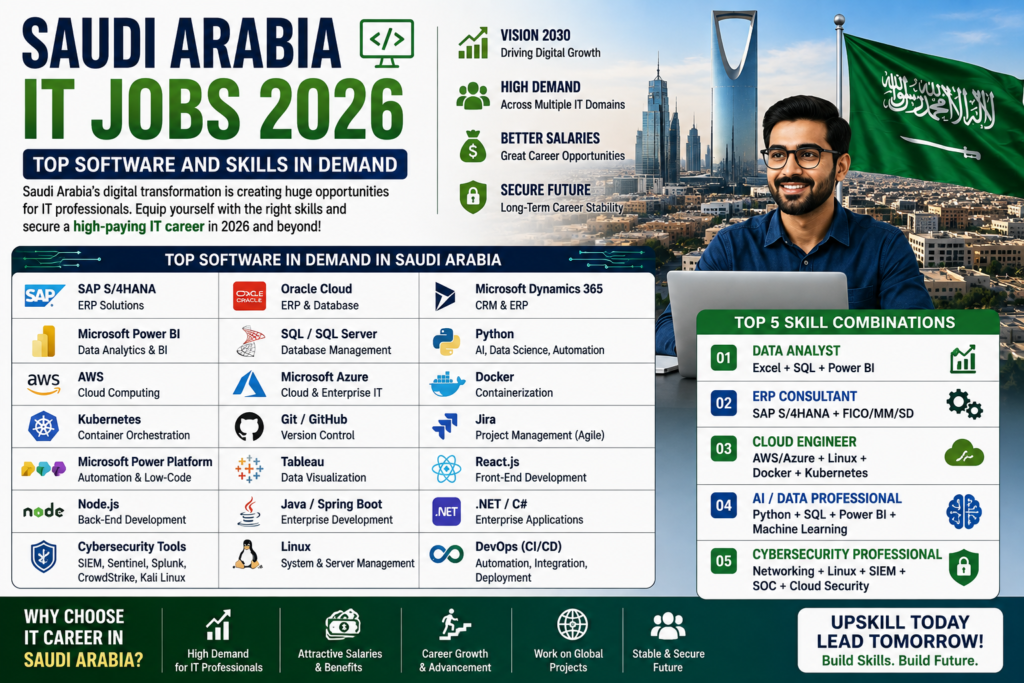
Want an IT Job in Saudi Arabia? Knowing Basic Computer Skills Is No Longer Enough.
Saudi Arabia’s technology market is changing rapidly. For Pakistani IT professionals planning to build a career in Saudi Arabia in 2026, one thing is becoming increasingly clear:
A degree alone is not enough. Employers are looking for practical technology skills, specialized software knowledge, and professionals who can solve real business problems.
Saudi Arabia’s Vision 2030 transformation is accelerating digitalization across businesses, government services, healthcare, finance, construction, logistics, tourism, manufacturing, and other industries. Current technology research indicates that Saudi organizations are placing major emphasis on AI and automation, data and analytics, cybersecurity, cloud technologies, Agile/DevOps, and low-code solutions.
For Pakistani professionals, this creates significant opportunities—but also stronger competition.
The right strategy is not to learn 20 different software tools at a basic level. Instead, choose a career specialization and develop a connected set of high-value technologies.
For more professional career and IT insights, connect with Mian Muhammad Tayyab on LinkedIn.
Below are some of the most useful software platforms and technologies for professionals targeting Saudi Arabia IT jobs.
1. SAP S/4HANA – A Strong Choice for ERP Careers
SAP is one of the most important enterprise technology ecosystems for professionals interested in ERP careers.
Popular SAP areas include:
- SAP S/4HANA
- SAP FICO
- SAP MM
- SAP SD
- SAP PP
- SAP HCM
- SAP ABAP
- SAP Basis
Best for: ERP consultants, business analysts, finance professionals, supply-chain professionals, and enterprise IT specialists.
Learning SAP together with a business specialization can make your profile considerably stronger than simply having general SAP knowledge.
2. Oracle Cloud and Oracle ERP
Oracle is another important enterprise technology platform.
Professionals can specialize in:
- Oracle Cloud
- Oracle ERP
- Oracle Database
- Oracle HCM
- Oracle Financials
- Oracle Cloud Infrastructure (OCI)
Best for: Cloud engineers, database administrators, ERP consultants, finance professionals, and enterprise IT specialists.
3. Microsoft Dynamics 365
Microsoft Dynamics 365 combines CRM and ERP capabilities and is highly relevant to business technology environments.
Important areas include:
- Dynamics 365 Sales
- Customer Service
- Finance
- Supply Chain Management
- Business Central
- CRM
- Microsoft Power Platform
Best for: Business analysts, CRM consultants, ERP professionals, and Microsoft technology specialists.
4. Microsoft Power BI – A Practical Route into Data Analytics
If you want to become a Data Analyst or Business Intelligence professional, Power BI + SQL + Excel is one of the most practical combinations to consider.
Power BI can be used to:
- Create business dashboards
- Analyze company data
- Track KPIs
- Build management reports
- Identify business trends
- Support data-driven decisions
Data and analytics are among the technology areas receiving significant attention from Saudi organizations.
A strong beginner-to-professional combination is:
Excel + SQL + Power BI
This can provide a practical foundation for Data Analyst and Business Intelligence roles.
5. SQL – A Core Skill for Data and Database Careers
SQL is one of the most useful technical skills for anyone entering data-related IT careers.
SQL can be combined with:
- Power BI
- Python
- Data Analytics
- Database Administration
- Business Intelligence
- Software Development
For aspiring Data Analysts, a particularly useful combination is:
SQL + Power BI + Excel
Instead of learning SQL only theoretically, build projects using real or publicly available datasets.
6. Python – AI, Data Science, and Automation
Python has become a major technology for AI, data science, automation, and software development.
It can be used for:
- Artificial Intelligence
- Machine Learning
- Data Science
- Data Analysis
- Automation
- Backend Development
A strong AI and data learning path could include:
Python + SQL + Statistics + Machine Learning + Power BI
AI and automation are among the major technology priorities identified in Saudi Arabia’s 2026 technology outlook.
7. AWS – Cloud Computing
Cloud computing is becoming increasingly important across modern enterprise IT environments.
AWS skills can lead toward roles such as:
- Cloud Engineer
- AWS Solutions Architect
- Cloud Administrator
- DevOps Engineer
- Cloud Security Engineer
For stronger employability, combine AWS with:
Linux + Networking + Docker + Kubernetes + DevOps
8. Microsoft Azure
Microsoft Azure is another major cloud platform and is particularly relevant to organizations heavily invested in the Microsoft ecosystem.
Azure professionals can specialize in:
- Cloud Administration
- Cloud Architecture
- DevOps
- Cloud Security
- Networking
- AI
- Data Services
A useful career combination is:
Azure + Linux + Networking + PowerShell + DevOps
9. Docker and Kubernetes – Important for DevOps
If your goal is to become a DevOps or cloud-native professional, Docker and Kubernetes are important technologies.
A stronger DevOps skill stack includes:
Linux + Git + Docker + Kubernetes + CI/CD + Cloud
Learning Docker or Kubernetes in isolation is less useful than understanding how these technologies work together in real deployment environments.
10. Git and GitHub – Essential for Developers
Git is a fundamental version-control system used by software development teams.
Git and GitHub are useful for:
- Source-code management
- Version control
- Team collaboration
- Project management
- Software portfolios
- Open-source projects
Pakistani developers applying for Saudi Arabia software jobs can strengthen their profiles by maintaining a professional GitHub portfolio with real projects.
11. Jira – Agile and Software Project Management
Jira is widely used for project management, issue tracking, and Agile software development workflows.
It can be particularly useful for:
- Scrum teams
- Agile project management
- Business analysts
- Software project managers
- Product teams
- Developers
Learning Jira together with Agile and Scrum concepts is more valuable than simply learning how to navigate the software.
12. Microsoft Power Platform – Business Automation
Microsoft Power Platform is becoming increasingly useful for organizations looking to automate business processes.
Its main technologies include:
- Power BI
- Power Apps
- Power Automate
- Power Pages
This can be a good career path for professionals interested in business automation, low-code development, reporting, and process optimization.
Saudi technology research has highlighted low-code, Agile, and DevOps among areas with significant near-term scaling interest.
13. Tableau – Data Visualization
Tableau is another important business intelligence and data-visualization platform.
It allows professionals to transform complex datasets into interactive visual reports and dashboards.
For someone entering data analytics, however, it is usually better to master one visualization platform first rather than trying to learn Power BI and Tableau simultaneously.
Good options include:
SQL + Power BI
or
SQL + Tableau
14. React.js – Front-End Development
React.js is an important technology for modern web development.
A front-end developer should consider learning:
- HTML
- CSS
- JavaScript
- React
- TypeScript
- Git
- REST APIs
A practical learning path is:
HTML → CSS → JavaScript → React → Git → APIs
Building several real websites or applications will make your portfolio much stronger.
15. Node.js – Back-End Development
Node.js allows developers to build server-side applications using JavaScript.
It can be combined with React to create a full-stack development profile.
A possible full-stack roadmap is:
HTML → CSS → JavaScript → React → Node.js → SQL/MongoDB → Git
16. Java and Spring Boot
Java remains relevant for enterprise software development.
Java and Spring Boot can be useful for professionals targeting:
- Enterprise applications
- Backend development
- Banking technology
- Large-scale business systems
- API development
- Microservices
Professionals with Java, Spring Boot, SQL, Git, and cloud knowledge can target a broader range of enterprise development positions.
17. NET and C#
C# and .NET are particularly useful for developers working within the Microsoft technology ecosystem.
A strong enterprise-development combination can be:
C# + .NET + SQL Server + Azure + Git
This can prepare professionals for backend, enterprise application, and cloud-integrated development roles.
18. Cybersecurity Tools and Technologies
Cybersecurity should not be viewed as a single software skill.
A cybersecurity professional needs a broader technical foundation that can include:
- Networking
- Linux
- SIEM
- Endpoint security
- Vulnerability management
- Identity and access management
- Cloud security
- Incident response
Commonly used tools and platforms include:
- Microsoft Sentinel
- Splunk
- CrowdStrike
- Wireshark
- Nessus
- Burp Suite
- Kali Linux
Cybersecurity is one of the major technology priorities for Saudi organizations. Current Saudi technology research reported very strong near-term scaling intentions for cybersecurity capabilities.
Top 5 IT Skill Combinations for Saudi Arabia Jobs in 2026
If you are unsure what to learn, don’t try to master everything.
Choose one career direction.
Option 1 – Data Analyst
Excel + SQL + Power BI
A practical route for beginners and business-focused professionals.
Option 2 – ERP Consultant
SAP S/4HANA + FICO/MM/SD
Suitable for professionals interested in enterprise systems, finance, supply chain, and business processes.
Option 3 – Cloud Engineer
AWS/Azure + Linux + Networking + Docker + Kubernetes
A strong combination for cloud and infrastructure careers.
Option 4 – AI/Data Professional
Python + SQL + Power BI + Machine Learning
Suitable for professionals targeting AI, analytics, and data-driven roles.
Option 5 – Cybersecurity Professional
Networking + Linux + SIEM + SOC + Cloud Security
A practical foundation for security operations and cybersecurity careers.
How Pakistani IT Professionals Can Prepare for Saudi Jobs
The first step is to choose a specialization.
Then focus on three to five interconnected technologies instead of collecting dozens of unrelated certificates.
For example, an aspiring Data Analyst could follow:
Excel → SQL → Power BI → Real Projects → Portfolio → Targeted Job Applications
A Cloud Engineer could follow:
Networking → Linux → Azure/AWS → Docker → Kubernetes → Projects → Certification → Job Applications
A Cybersecurity professional could follow:
Networking → Linux → Security Fundamentals → SIEM → SOC Labs → Cloud Security → Certification → Applications
This approach creates a coherent professional profile rather than a CV filled with unrelated software names.
Don’t Just Collect Certificates—Build Projects
One of the biggest mistakes IT candidates make is believing that certificates automatically lead to employment.
Certificates can help demonstrate structured learning, but practical projects show what you can actually do.
For example:
Power BI: Build a sales or financial-performance dashboard.
Python: Create a data-analysis or automation project.
React: Build a professional business website or web application.
Cloud: Deploy a real application or infrastructure project.
Cybersecurity: Complete legal SOC and security-lab exercises.
Instead of simply writing:
“I know Power BI.”
A stronger CV statement would be:
“Created an interactive sales-performance dashboard using Power BI and SQL to analyze revenue, regional performance, and monthly KPIs.”
That difference matters.
Saudi Arabia IT Jobs 2026: The Bottom Line
Saudi Arabia’s technology market is moving toward more specialized digital capabilities. AI, automation, data analytics, cybersecurity, cloud computing, modern software development, and enterprise platforms are becoming increasingly important as organizations continue their digital transformation.
For Pakistani IT professionals, the opportunity is significant—but the strategy should be focused.
Don’t try to become an expert in every technology.
Instead:
Choose One Career → Master Core Skills → Build Real Projects → Earn Relevant Certifications → Create a Strong CV → Apply Strategically
If you want to become a Data Analyst, focus on SQL + Power BI + Excel.
For ERP, consider SAP or Oracle.
For cloud, focus on AWS/Azure + Linux + DevOps.
For cybersecurity, build skills around Networking + Linux + SIEM + Security.
For AI and data, focus on Python + SQL + Machine Learning.
For software development, build a strong stack around React/Node.js, Java/Spring Boot, or C#/.NET, depending on your target market.
The Saudi IT market is not simply looking for people who can use computers. It needs professionals who can build systems, analyze data, secure infrastructure, automate processes, manage enterprise platforms, and solve real business problems.
The right skill today can become your biggest career advantage tomorrow.
Connect on LinkedIn
For professional networking, technology insights, career opportunities, and updates related to Saudi Arabia and Gulf jobs, connect with Mian Muhammad Tayyab on LinkedIn.
Hashtags
#SaudiArabiaJobs #SaudiJobs2026 #ITJobsSaudiArabia #PakistanisInSaudiArabia #ITJobsForPakistanis #SaudiITJobs #TechJobsSaudiArabia #SoftwareJobs #SAPJobs #PowerBI #DataAnalytics #CyberSecurity #CloudComputing #AWS #MicrosoftAzure #Python #DevOps #Kubernetes #Docker #SoftwareDeveloper #DataAnalyst #SaudiArabiaCareers #PakistanJobs #GulfJobs #Vision2030 #TechCareers #SaudiJobs #ITCareer #CareerOpportunities #JobsInSaudiArabia
Professional Profile: Mian Muhammad Tayyab | LinkedIn
