
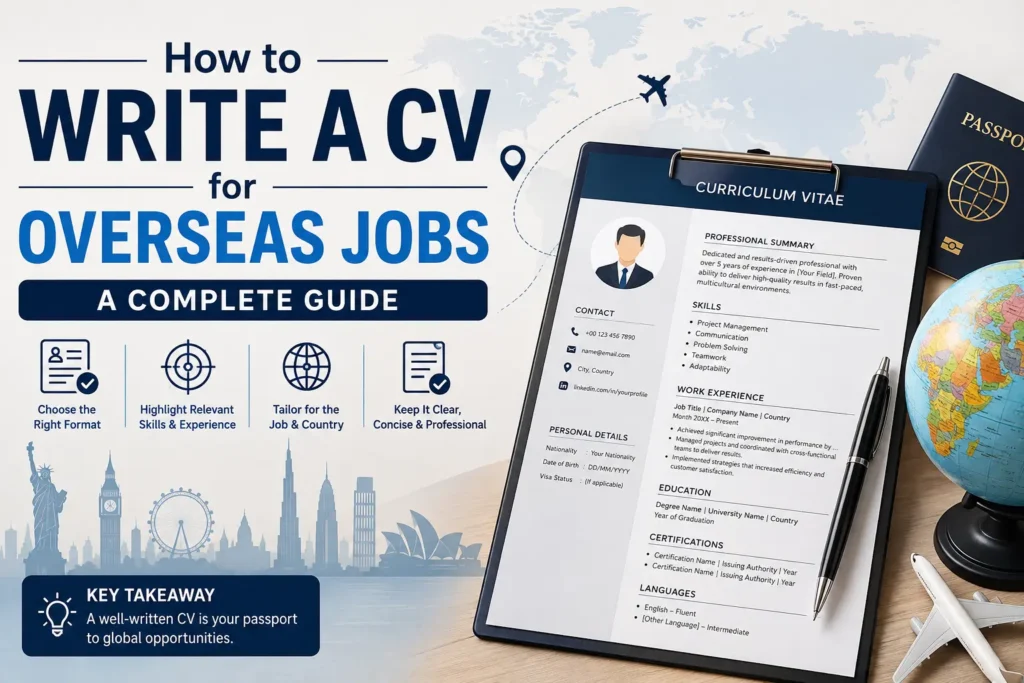
Planning to apply for a job abroad? Before you start sending applications, take a close look at your CV.
For many overseas jobs, your CV is the first thing an employer sees. It needs to make your experience easy to understand and, more importantly, show why you are a good fit for the position.
But writing a CV for an overseas job isn’t simply a matter of taking your existing CV and changing the design. Different countries and employers have different expectations about what a CV should contain and how it should be presented. There is no single international CV format that works everywhere.
This is particularly important if you’re applying from Pakistan for jobs in Saudi Arabia, the UAE, Qatar, Kuwait, Oman or Bahrain.
In this guide, we’ll walk through what to include in your CV, how to format it, how to tailor it for different jobs, and the mistakes you should avoid.
What Is an Overseas Job CV?
You don’t need to rewrite your entire CV every time. A few well-chosen changes to your summary, skills.
An overseas job CV is simply a CV prepared for an employer in another country.
The basic information remains the same: your contact details, work experience, education, skills and qualifications. What changes is how you present that information and which details you emphasize.
For example, an employer may want to know where you currently live, whether you are willing to relocate or what your current visa status is. These expectations can vary depending on the country, employer and position.
That’s why it is better to have a master CV containing your complete professional history and then adjust it for the jobs you actually apply for.
What to Include in a CV for Overseas Jobs

There isn’t one fixed list of sections that every overseas CV must have. Your profession and destination country matter.
However, most job seekers should start with the following sections.
Contact Information
Put your contact details at the top of the CV so an employer doesn’t have to search for them.
Include:
- Full name
- Professional email address
- Phone number with your international country code
- Current city and country
- LinkedIn profile, if you have one
- Portfolio or professional website, if relevant
If you’re applying from Pakistan, don’t just write your local phone number. Use the international format with +92 so an overseas employer can identify the number easily.
You don’t need to fill this section with unnecessary personal information. Only include details that are relevant to the application or specifically requested by the employer.
Professional Summary
Think of your professional summary as your introduction to the employer.
In two or three sentences, tell them:
- What you do
- How much relevant experience you have
- What your main strengths are
- What type of position you’re looking for
For example:
Skilled electrician with 7 years of experience in commercial and residential electrical installation, maintenance and troubleshooting. Experienced in preventive maintenance, electrical safety and working with technical teams. Seeking an electrician opportunity with a reputable employer in Saudi Arabia.
Compare that with:
“I am a hardworking and dedicated person looking for a challenging position.”
The second version could describe almost anyone. The first immediately tells the employer what you actually bring to the table.
A good profile should focus on your relevant skills and the value you can bring to the role.
Work Experience
For most experienced workers, this will be one of the most important sections of the CV.
For each relevant job, include:
- Job title
- Company name
- Location
- Employment dates
- Main responsibilities
- Important achievements
Start with your most recent experience and work backwards.
But don’t turn your CV into a list of everything you did every day.
Instead of:
Responsible for managing construction workers.
You could write:
Supervised a team of 25 construction workers and coordinated daily site activities to keep projects on schedule.
Whenever you can, add numbers.
For example:
- Managed a team of 15 employees.
- Completed more than 30 electrical installations.
- Reduced equipment downtime by 20%.
- Served more than 100 customers per day.
Numbers give employers a better idea of the scale of your experience.
Education and Qualifications
List your relevant education and professional qualifications clearly.
Depending on your background, this could include:
- Degree
- Diploma
- Technical qualification
- Institution
- Field of study
- Graduation or completion year
If your profession requires a particular qualification or license, don’t bury it at the bottom of the CV. Make sure it is easy to find.
Skills
Your skills section should reflect the job you’re applying for.
For example, a construction worker might list:
- Construction site safety
- Equipment operation
- Site preparation
- Concrete work
- Team coordination
An IT professional might list:
- JavaScript
- React
- Node.js
- SQL
- Cloud platforms
Try to avoid filling this section with vague words such as “hardworking,” “honest” or “punctual.” These qualities may be valuable, but your experience should demonstrate them.
Focus on skills that an employer can actually use to assess whether you’re suitable for the position.
Certifications and Licenses
If you have professional certifications or licenses that are relevant to the position, give them their own section.
Depending on your profession, these might include:
- Trade certifications
- Professional licenses
- Health and safety certifications
- Technical certifications
- Driving licenses
- Industry-specific qualifications
Only include genuine and relevant credentials.
Languages
If you speak more than one language, list your languages and indicate your level of proficiency.
For example:
- Urdu — Native
- English — Professional
- Arabic — Intermediate
Language ability can be particularly useful for people applying to the Gulf, where employees often work in multicultural teams.
How to Format Your CV for Overseas Employers
A good CV doesn’t need to look complicated.
In fact, a simple CV is often easier for both recruiters and automated systems to read.
Use clear headings, consistent spacing, readable fonts and bullet points. The goal is to make it possible for someone to understand your background quickly.
Choose the Right CV Length
There is no universal page limit for an overseas CV.
Requirements can vary significantly between countries.
As a practical guideline:
- Fresh graduates: around 1 page
- Early-career professionals: 1–2 pages
- Experienced professionals: 2 pages or more when the additional information is genuinely relevant
Don’t add information just to make your CV longer.
If you have 15 years of experience, you don’t necessarily need to describe every responsibility from your first job in detail.
Use a Professional Layout
Keep the design clean and easy to scan.
Use:
- Clear section headings
- Consistent font sizes
- Adequate spacing
- Bullet points
- Consistent date formatting
- Readable fonts
Avoid:
- Excessive graphics
- Decorative fonts
- Huge blocks of text
- Too many colors
- Unnecessary icons
- Complicated layouts
A recruiter shouldn’t have to figure out how your CV works before they can understand your experience.
Keep Your CV ATS-Friendly
You may have heard the term ATS, or Applicant Tracking System.
Many employers use software to help manage and filter job applications. This means your CV should be easy for both software and people to read.
A few simple practices can help:
- Read the job description carefully.
- Identify the skills and qualifications the employer mentions.
- Use relevant keywords naturally in your CV.
- Use familiar headings such as “Work Experience,” “Education” and “Skills.”
- Avoid unnecessarily complicated formatting.
- Make sure important information is actual text rather than part of an image.
Don’t copy the job description word-for-word. If you don’t actually have a particular skill, don’t add it just because it appears in the vacancy.
How to Tailor Your CV for Different Overseas Jobs
This is one of the easiest ways to improve your applications.
Imagine you’re an electrician with experience in installation, maintenance and troubleshooting.
You find one vacancy looking for an electrician with strong maintenance experience. Another is focused mainly on new construction projects.
You can use the same overall CV for both, but the emphasis should change.
For the maintenance position, you might bring preventive maintenance and troubleshooting higher up in your CV.
For the construction position, you might highlight installation and project experience instead.
You can tailor:
- Professional summary
- Skills
- Order of experience bullets
- Relevant achievements
- Job-specific terminology
The idea isn’t to create a completely new CV for every application. It’s to make the most relevant parts of your existing experience easier to spot.
Research on international job applications also recommends adapting application materials to the target job and region.
Common CV Mistakes to Avoid When Applying Abroad
Even experienced professionals can make simple CV mistakes.
Using the Same CV for Every Job
If every application uses exactly the same CV, you may be hiding your most relevant experience.
Take a few minutes to adjust it for each serious application.
Including Too Much Irrelevant Information
Your CV doesn’t need to tell your entire life story.
If something doesn’t help demonstrate that you’re suitable for the job, consider leaving it out.
Spelling and Grammar Errors
A few small errors can make an otherwise strong CV look rushed.
Read through the final version carefully before sending it.
If English isn’t your first language, consider having someone proficient in English review it.
Using an Unprofessional Email Address
A professional email address based on your name is usually the safest choice.
For example:
muhammad.ahmed@email.com
is much more appropriate than an old nickname or informal address.
Listing Duties Without Showing Results
Saying what you were responsible for is useful.
Showing what you achieved is better.
Whenever possible, turn responsibilities into specific accomplishments.
Overdesigning Your CV
A colorful, highly designed CV might look impressive on your screen, but it isn’t necessarily better for recruitment.
Especially when applying online, prioritize clarity and readability.
Indeed’s current resume-upload guidance, for example, recommends avoiding graphics and two-column layouts in uploaded resumes because they can interfere with how information is processed.
Providing False Information
Never exaggerate your experience, qualifications, licenses or certifications.
An overseas employer may verify your credentials during the recruitment process, and inaccurate information can damage your chances of getting the job.
Should You Include a Photo on an Overseas CV?
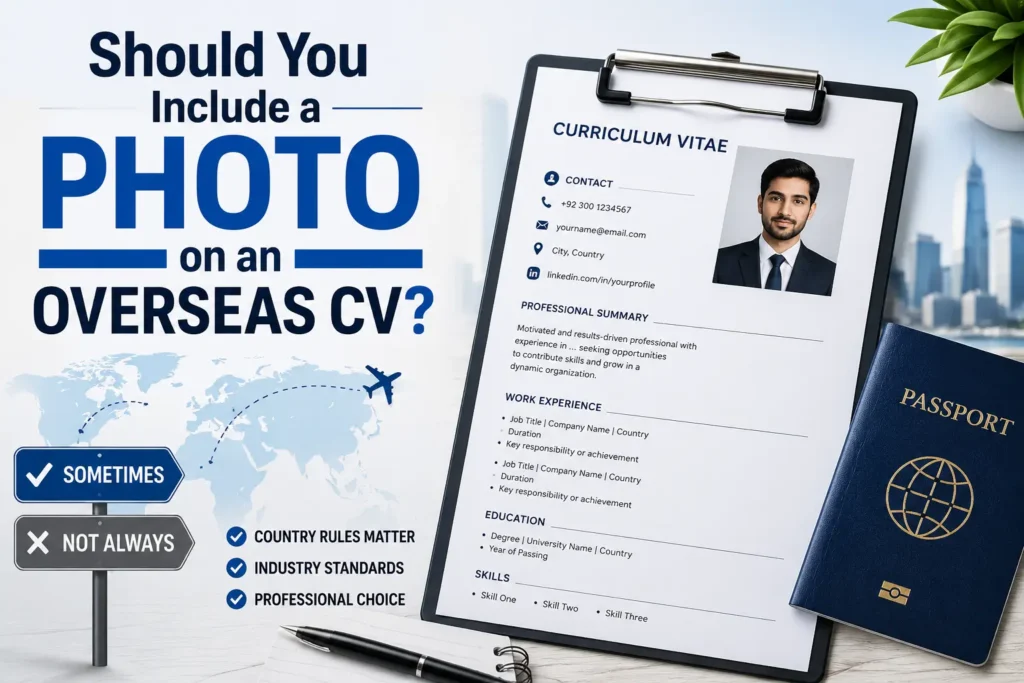
This is one of those questions where the answer is: it depends.
There isn’t a universal international rule about CV photographs. Expectations vary by country and employer.
For some Gulf applications, a professional photograph may be customary. For others, particularly certain corporate or technical positions, it may not be necessary.
If the job advertisement specifically asks for a photograph, follow the employer’s instructions.
If it doesn’t, check the conventions of the country and industry before deciding.
And if you do include one, use a professional headshot—not a cropped holiday photo or casual selfie.
Should You Include Your Nationality, Date of Birth or Marital Status?
Again, don’t assume that every country follows the same rules.
Some countries and employers may request personal information such as nationality, date of birth or visa status, while others generally don’t.
For Gulf applications, requirements can be more specific. For example, current UAE-focused recruitment guidance commonly recommends including information such as nationality, location and visa status, although individual employers may have different requirements.
The best approach is simple:
Follow the requirements of the specific job and employer.
Don’t add sensitive personal information just because you’ve seen it on someone else’s CV.
Example of a Good Overseas Job CV
Here’s a simple example of how an overseas CV could be structured for an electrician applying from Pakistan.
MUHAMMAD AHMED
Lahore, Pakistan | +92 XXX XXXXXXX | email@example.com
LinkedIn: linkedin.com/in/example
Professional Summary
Electrician with 7 years of experience in electrical installation, maintenance and troubleshooting across commercial and residential projects. Experienced in preventive maintenance, electrical safety and team coordination.
Work Experience
Electrician — ABC Construction Ltd.
Lahore, Pakistan | 2021–Present
- Installed and maintained electrical systems across commercial projects.
- Performed preventive maintenance and fault diagnosis.
- Worked with a team of 12 technicians.
- Followed workplace electrical safety procedures.
Electrician — XYZ Services
Lahore, Pakistan | 2018–2021
- Installed residential electrical systems.
- Diagnosed electrical faults.
- Completed maintenance work for residential and commercial customers.
Education
Diploma in Electrical Technology
Technical Institute, Pakistan | 2018
Skills
- Electrical Installation
- Preventive Maintenance
- Fault Diagnosis
- Electrical Safety
- Equipment Maintenance
Certifications
- Relevant Electrical Certification
- Workplace Safety Certification
Languages
- Urdu — Native
- English — Professional
- Arabic — Basic
This is only an example. Your own CV should reflect your actual experience, profession and the requirements of the position you’re applying for.
CV Tips for Pakistani Workers Applying for Gulf Jobs
If you’re applying from Pakistan for a Gulf job, a few practical details can make your CV easier for employers to assess.
Use an International Phone Number Format
Make sure your phone number includes +92 so an employer outside Pakistan can identify it immediately.
Clearly Show Your Current Location
If you’re currently in Pakistan, say so.
For example:
Lahore, Pakistan
This prevents confusion about whether you’re already living in the country where the job is based.
Highlight Relevant Certifications
If your profession requires technical qualifications, licenses or certifications, make them easy to find.
This can be particularly important for skilled trades and regulated professions.
Be Honest About Your Availability
If you’re willing to relocate, you can say so.
But don’t claim that you already have a residence permit, work visa or local employment status if you don’t.
Highlight Gulf-Relevant Experience
If you’ve previously worked in the Gulf, don’t hide it somewhere in the middle of your work history.
Make the location clear.
For example:
Electrician — ABC Contracting, Riyadh, Saudi Arabia | 2022–2025
That immediately tells the employer that you’ve already worked in the Saudi market.
Don’t Assume Every Gulf Country Uses the Same CV Requirements
Saudi Arabia, the UAE, Qatar, Kuwait, Oman and Bahrain are separate employment markets.
A CV that works well for one vacancy may need adjustments for another.
Before applying, check the job advertisement carefully and follow the employer’s requirements.
How to Make Your CV Stand Out to Overseas Employers
You don’t need an elaborate design to make a CV stand out.
You need to make the right information easy to find.
A recruiter should be able to answer three basic questions quickly:
Who are you?
Your job title, professional summary and recent experience should make this clear.
What can you do?
Your skills, qualifications and previous work should answer this question.
What have you achieved?
This is where specific results can make your CV stronger.
Instead of:
Experienced sales employee.
Try:
Sales representative with 5 years of experience managing B2B accounts and consistently exceeding monthly sales targets.
The second version gives the employer something concrete to evaluate.
Final CV Checklist Before Applying
Before you click Apply, take a few minutes to check your CV.
- Your name and contact details are correct.
- Your phone number includes the appropriate country code.
- Your email address is professional.
- Your professional summary matches the position.
- Your most recent relevant experience appears first.
- Your achievements are clearly explained.
- Your skills match the job requirements where applicable.
- Relevant certifications and licenses are included.
- Your language skills are accurate.
- The CV is easy to read.
- Spelling and grammar have been checked.
- You haven’t included false or exaggerated information.
- You’ve followed the employer’s application requirements.
- You’ve tailored the CV to the vacancy.
- The file has a professional name, such as Muhammad_Ahmed_Electrician_CV.pdf.
Ready to Find Overseas Job Opportunities?
A good CV can help you get noticed, but it is only the first part of the process.
The next step is finding genuine opportunities that actually match your skills and experience.
If you’re looking for opportunities in Saudi Arabia, UAE, Qatar, Kuwait, Oman or Bahrain, explore the latest vacancies on Gulf Job Works.
Frequently Asked Questions
What should I include in a CV for an overseas job?
Start with your contact information, professional summary, work experience, education, relevant skills, certifications and languages. Depending on the country and employer, additional information may be required.
How many pages should an overseas CV be?
There is no universal rule. A fresh graduate may only need one page, while an experienced professional may need two or more. The important thing is to keep the information relevant.
Should I include a photo on my overseas CV?
It depends on the country, industry and employer. Check the job advertisement and local expectations before deciding.
Should I mention my nationality on my CV?
It depends on the destination country and employer. Some Gulf employers may request nationality or visa information, while others may not. Follow the specific application requirements.
Should an overseas CV be ATS-friendly?
Yes. If you’re applying online, use clear headings, straightforward formatting and relevant keywords that accurately describe your experience.
Can I use the same CV for every overseas job?
You can use the same master CV as a starting point, but it’s better to tailor it for each position. Adjust your summary, skills and most relevant experience to match the vacancy.
References
- Indeed — How To Write an International Resume
- Indeed — What To Include in Your CV
- Indeed — How To Get a Job in Another Country
- Indeed — How To Apply for a Job Overseas
- Bayt — CV Format for UAE Jobs: The Complete 2026 Guide
- Bayt — How Recruiters in the GCC Actually Read Your CV
